Configuring Income
Income covers the different income categories from the investments. For example, within a real estate investment pool you may have income categories for rental property income and another for business property income.
You can:
- Create different income categories by selecting Create Income Category.
- Edit existing options by selecting the Actions button and then choosing Create New Version.
- View existing options by selecting the Actions button and then opting for View.
- Copy existing options by selecting the Actions button and then choosing Create New Income from this.
- Deactivate existing options by selecting the Actions button and choosing Deactivate.
- Delete existing options by selecting the Actions button and then opting for Delete.
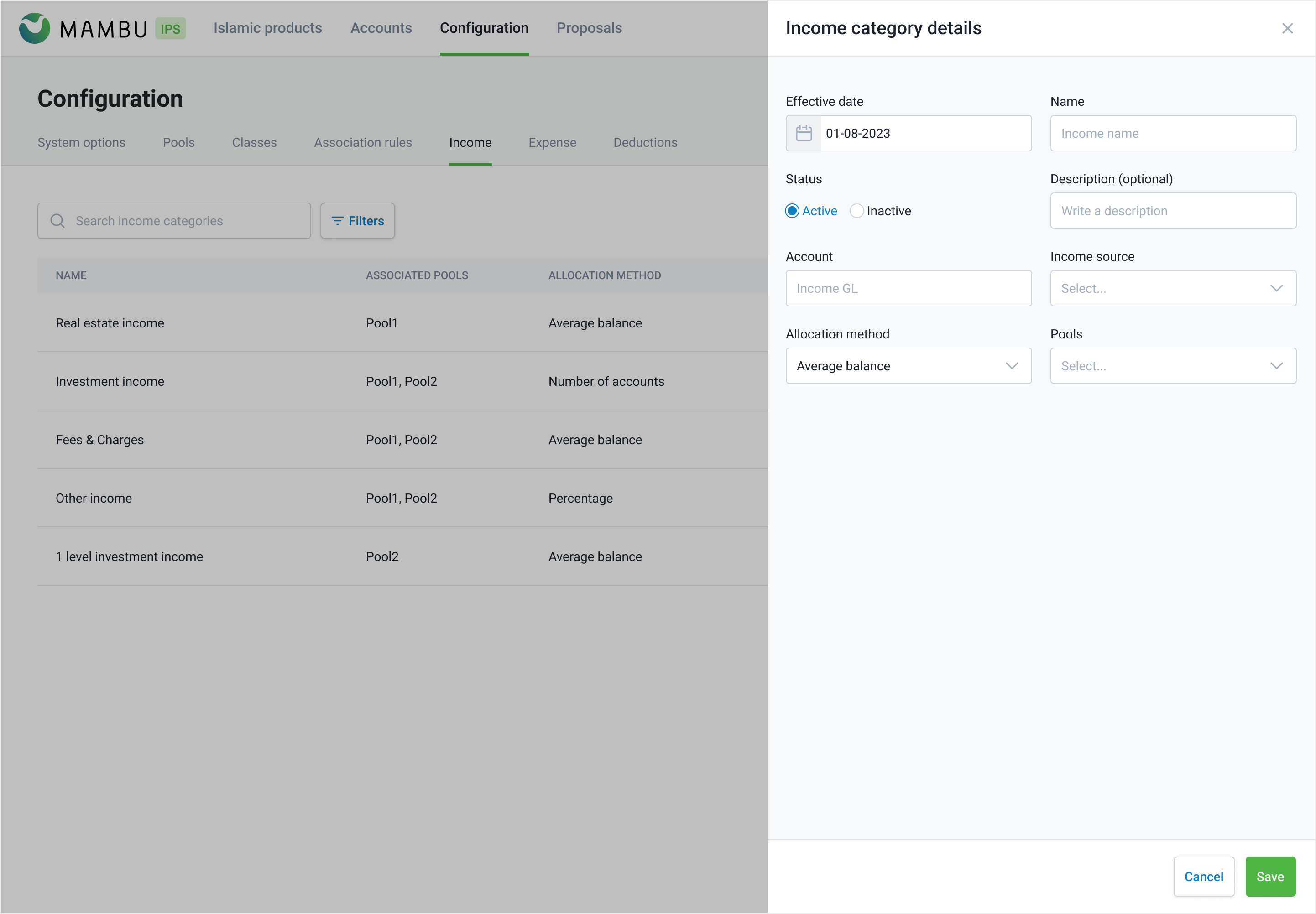
Income parameters
| Parameter | Description | Required |
|---|---|---|
| Effective date | The date when the change should be implemented. | YES |
| Name | The name of the income category. Include at least 3 or more letters or numbers, symbols cannot be used. | YES |
| Status | Whether the income category is currently active or inactive. | YES |
| Description | Document additional details or context related to the income category. | NO |
| Account | Identifies the GL account associated with the income. | YES |
| Income source | The source of the income. NOTE: default value - Islamic finance, not editable for Early Access. | YES |
| Allocation method | Specifies the method employed for allocating profits (Select option from drop-down: Average balance (default); Number of accounts; Percentage). Will not have any impact if the pool:income relationship is 1:1. | YES |
| Pools | The investment pools that are associated within the profit-sharing system. | YES |
Allocation method
-
Average Balance (Default): This method calculates profit allocation based on the average balance of accounts over a specified period, typically a day or a month. It ensures that profit distribution reflects the overall balance of accounts during the defined period.
-
Number of Accounts: With this method, profit allocation is determined by the total number of accounts participating in the profit-sharing scheme. Each account receives an equal share of the total profit, regardless of individual balances. It provides a more egalitarian approach to profit distribution.
-
Percentage: This method allocates profit based on the percentage of each account's balance relative to the total balance of all participating accounts. Accounts with higher balances receive a proportionately higher share of the profit, reflecting their greater contribution to the pool of funds.