Profit Calculation
Profit calculations run in the backend, and Proposals present the results of the calculations with detailed information. Proposals run across all active pools available for the defined period, and give a breakdown of the profit parameters for each pool that falls within the calculation period. This is used to approve and apply the profits among the relevant accounts.
This section breaks down how profit is calculated for a pool. The calculations are performed for each monthly profit calculation cycle.
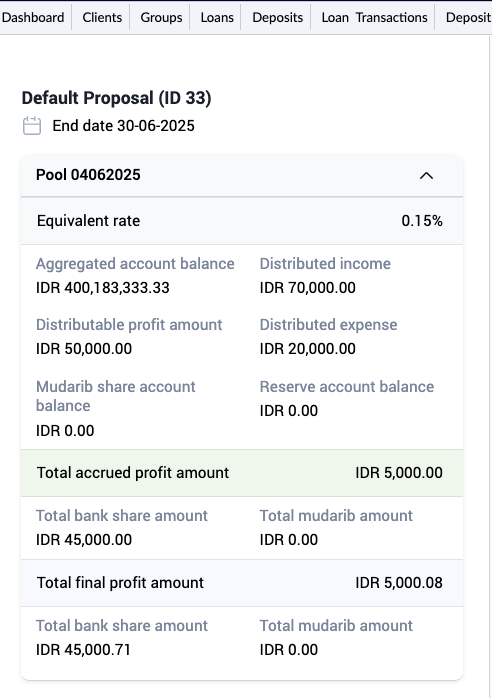
Calculating the Pool's equivalent rate
1. Distributed income: The sum of all income generated from the assets in the investment pool for the profit calculation cycle.
How Distributed Income is Calculated
The calculation method depends on whether Asset/Liability Check is enabled at Pool level.
When Asset/Liability Check is DISABLED (default)
Formula
Distributed Income = Σ Total Income from all Financing Income categories linked to the Pool
- Only Financing Income categories contribute to distributable profit.
- Other Productive Asset Income is excluded.
When Asset/Liability Check is ENABLED
The system compares the Pool's Aggregated Account Balance (total deposit liabilities) against the Total Asset per Pool (sum of income-generating asset GL balances) and applies one of two calculation methods:
Case A — Liabilities ≤ Financing Assets
When total deposits are less than or equal to financing assets:
Formula
Distributed Income = Total Financing Income × (Aggregated Account Balance ÷ Financing Asset)
The pool only distributes the proportion of financing income that corresponds to customer funding. The remaining income (funded by bank equity) belongs to the bank.
Case B — Liabilities > Financing Assets
When total deposits exceed financing assets:
Formula
Distributed Income = (Total Financing Income + Total Other Productive Asset Income) × MIN(1, Aggregated Account Balance ÷ (Financing Asset + Other Productive Asset))
Other Productive Asset income (Sukuk, investments, interbank placements) is included to fund the customer deposits that financing assets alone cannot cover.
Concrete Example: X Bank Islamic — April 2026
Pool Configuration:
- Asset/Liability Check: ENABLED
- Currency: AED
- Days in Year / Month: 360 / 30
Income Sources:
| Income Category | Type | Total Income (Cycle) | Asset GL Balance (Avg) |
|---|---|---|---|
| Sukuk & Investments | Other Productive Asset Income | AED 266.25 | AED 71,000 |
| Financing Income (Murabaha) | Financing Income | AED 0 | AED 0 |
Pool Composition:
| Component | Amount |
|---|---|
| Shareholders' Equity | AED 21,000 |
| Mudaraba Deposits (customer liabilities) | AED 50,000 |
| Total Pool (Aggregated Account Balance) | AED 71,000 |
Calculation:
- Determine which case applies:
- Aggregated Account Balance = AED 71,000
- Financing Asset = AED 0
- Other Productive Asset = AED 71,000
- Since Liabilities (71,000) > Financing Assets (0) → Case B applies
- Apply Case B formula:
Distributed Income = (0 + 266.25) × MIN(1, 71,000 ÷ (0 + 71,000))
                   = 266.25 × MIN(1, 1.0)
                   = 266.25 × 1.0
                   = AED 266.25
Key Observations:
- Without A/L Check enabled, the Sukuk income (AED 266.25) would not be distributed because it's classified as "Other Productive Asset Income".
- With A/L Check enabled, all income is distributed because the pool's assets (71,000) exactly match the liabilities (71,000).
- If deposits were 80,000 but assets remained 71,000, the ratio would be 71,000 / 80,000 = 0.8875, and only 88.75% of income would be distributed (the remaining 11.25% would be reserved as the pool is underfunded).
- Negative balances are rounded to 0.
- Asset balance calculation: Day x = ending balance of Asset GL; Cycle = average of daily balances.
2. Distributed expenses: The sum of all direct expenses incurred in managing the investment pool for the profit calculation cycle.
How Distributed Expenses are Calculated
Expense categories linked to the Pool are aggregated and allocated based on the configured allocation method. Unlike income, expenses are not affected by the Asset/Liability Check setting — all linked expenses are always included in the calculation.
Formula
Distributed Expenses = Σ Total Expenses from all Expense categories linked to the Pool
Allocation Methods
When multiple Pools share the same expense category, expenses are distributed proportionally using one of three methods:
| Allocation Method | Formula | Use Case |
|---|---|---|
| Number of Accounts | Pool's Expense Share = Total Expense × (Accounts in Pool ÷ Total Accounts across all Pools) | Fair distribution when all accounts have similar impact on expenses |
| Average Balance | Pool's Expense Share = Total Expense × (Pool Agg Balance ÷ Total Agg Balance across all Pools) | Proportional to deposit size — larger pools bear more expense |
| Fixed % | Pool's Expense Share = Total Expense × Pool's Defined % | Manual allocation control (all pools must sum to 100%) |
Possible types of Expenses
Expense categories typically include:
- Operational Expenses
- Management fees
- Administrative costs
- Transaction processing fees
- Regulatory compliance costs
- Pool-Specific Deductions (workaround until Deductions feature is developed)
- Wakala fee (recommended as expense category per AAOIFI SS 46)
- Pool base reductions:
- Fixed assets offset
- CB cash reserve offset
- Cash in hand offset
- Staff financing offset
- Qard Hasan debit balances offset
- Prepaid expenses offset
- Investment in restricted funds offset
- Provisions
- Provisions for doubtful debts
- Investment loss reserves
Some Islamic banks prefer revenue sharing instead of profit sharing and may choose not to configure expense categories. In such cases, the entire income amount becomes the distributable profit without any expense deductions.
Concrete Example: X Bank Islamic — April 2026
Expense Categories Configured:
| Expense Category | GL Account | Amount (Cycle) | Pool Association | Allocation Method |
|---|---|---|---|---|
| Management Fees | E500001 | AED 0 | AED Pool | Average Balance |
| CB Cash Reserve Offset | E500010 | AED 0 | AED Pool | Fixed % (100%) |
| Cash in Hand Offset | E500011 | AED 0 | AED Pool | Fixed % (100%) |
Calculation:
Distributed Expenses = 0 + 0 + 0 = AED 0
In the April 2026 cycle, no expenses were recorded, meaning the full income (AED 266.25) becomes the distributable profit.
If expenses were recorded (hypothetical scenario), assume:
- Management Fees = AED 20
- CB Cash Reserve Offset = AED 14 (calculated outside Mambu, posted manually)
- Cash in Hand Offset = AED 15 (calculated outside Mambu, posted manually)
Distributed Expenses = 20 + 14 + 15 = AED 49
Distributable Profit = Distributed Income - Distributed Expenses
                     = 266.25 - 49
                     = AED 217.25
3. Distributable profit amount: The gross profit available for distribution to customers and the bank for the profit calculation cycle, before any deductions or Nisbah split (if applicable).
Formula
Distributable Profit amount = Distributed Income - Distributed Expenses
This represents the net profit generated by the Pool during the cycle, after accounting for all income sources and operational expenses, but before applying:
- PER (Profit Equalisation Reserve) deductions
- Nisbah split (Bank Share % / Customer Share %)
- IRR (Investment Risk Reserve) deductions
- WPI (Wakil's Performance Incentive) deductions
- Mudarib Share for Cap/Floor adjustments
Key Observations
- Distributable Profit Amount is calculated at Pool level — it applies to all products and accounts linked to that Pool.
- Asset/Liability Check affects Distributed Income — it determines which income types are included (Financing only vs. Financing + Other Productive Asset).
- Expenses are always deducted — regardless of A/L Check setting.
- Deductions (PER, IRR, WPI) are applied after this gross profit is calculated.
- Each currency Pool is independent — AED profit does not mix with USD profit.
- This amount drives the Pool Equivalent Rate — the base rate from which all product and account rates are derived.
4. Aggregated account balance: The sum of the average eligible balances from all accounts participating in the pool during the profit calculation cycle. It represents the total customer deposit balances that participate in profit sharing for a given Pool during a specific profit calculation cycle. It serves as:
- The denominator in the Pool Equivalent Rate calculation.
- The liability side in Asset/Liability Check comparisons.
- The base for proportional profit allocation across products and accounts.
Calculation Method
Formula
Aggregated Account Balance (Pool) = Σ Aggregated Account Balance (per account)
                                    for all accounts in products linked to the Pool
Where each account's Aggregated Account Balance is calculated as:
Formula
Account Aggregated Balance = Average of [Account Daily Balance]
                             from Cycle Start Date to Cycle End Date
The Account Daily Balance type is configured at Pool level and can be:
| Balance Type | Definition | When to Use |
|---|---|---|
| End of Day Balance | The last balance the account has at the end of each day | Most common — reflects actual closing position |
| Average Daily Balance | Average balance the account has during the day (across all intraday transactions) | When intraday activity is significant |
| Minimum Daily Balance | Lowest balance the account has during the day | Conservative approach — ensures profit only on guaranteed minimum funds |
When Asset/Liability Check is enabled, the system always uses End of Day Balance for the A/L comparison, regardless of the Pool's configured balance type setting. This override ensures consistency between asset and liability measurements.
Eligibility Rules
An account's balance is included in the Aggregated Account Balance calculation if:
- Account is linked to a product that is linked to the Pool.
- Account status is
ACTIVE,ACTIVE_IN_ARREARS,LOCKED, orDORMANT. - Account has a positive balance during the cycle (negative balances are rounded to 0).
- Account's product category is Shari'ah-based (e.g. Shari'ah-based Consumer Deposits).
Accounts are excluded if:
- Account status is
PENDING_APPROVAL,APPROVED(not yet activated), orCLOSED. - Account balance is negative (technical overdraft) — rounded to 0 before aggregation.
The Minimum Eligible Balance parameter at product / pool level is used to determine profit payment eligibility, but it does NOT affect whether an account's balance is included in the Aggregated Account Balance calculation for Pool Equivalent Rate purposes. Even accounts below the minimum eligible threshold contribute their balance to the pool aggregate.
5. Equivalent rate %: The annualized profit rate for the investment pool. This rate serves as a benchmark for distributing profit distribution to each account.
Also known as: Pool Equivalent Rate, Pool Return Rate, Pool Profit Rate.
Formula
Equivalent Rate % = (Distributable Profit * Days in Year) / (Aggregated Account Balance * Days in Cycle) * 100
Purpose and Use
The Equivalent Rate % is the single most important output of the pool-level calculation because:
- Benchmark for all products — every product's profit rate is derived from this rate via weightage adjustment.
- Annualized for comparability — allows comparison across cycles of different lengths (e.g. 28-day February vs. 31-day March).
- Performance indicator — measures the investment pool's actual return for the period.
- Regulatory reporting — often required for Sharia compliance reporting and central bank submissions.
- Customer communication — forms the basis for the rates disclosed to customers.
Calculate Pool Equivalent Rate (X Bank Islamic — April 2026):
Pool Equivalent Rate = (Distributed Income ÷ Aggregated Account Balance) × (Days in Year ÷ Days in Month)
                     = (266.25 ÷ 71,000) × (360 ÷ 30)
                     = 0.00375 × 12
                     = 0.045
                     = 4.50% per annum
6. Mudarib share account balance: The balance of the Mudarib share general ledger account on the first day of the cycle, used for profit adjustments.
7. Reserve account balance: The balance of the reserve general ledger account on the first day of the cycle.
Calculating total accrued profit amount
The total accrued profit amount is the sum of the accrued profit amounts calculated for all individual products and accounts within the pool during the profit calculation cycle.
- Total bank share amount: The bank's total share of the accrued profit. It is derived by calculating the allocated portion from each account in the pool for the profit calculation cycle.
- Total Mudarib amount: The total value of all profit adjustments made across all accounts. It is derived by calculating the difference between the initial profit amount and the final profit amount, after adjustments, for every account in the pool for the profit calculation cycle.
Calculating total final profit amount
The total final profit amount is the sum of the final profit amounts calculated for all individual products and accounts within the pool during the profit payment cycles.
- Total bank share amount: The bank's final, total share of the profit after all adjustments have been applied across all accounts in the pool for the profit payment cycles.
- Total Mudarib amount: The total value of all profit adjustments made across all accounts. It is derived by calculating the difference between the initial profit amount and the final profit amount, after adjustments, for every account in the pool for the profit payment cycles.
Product profit calculation result
- Product: The name of the product and the number of accounts in a product.
- Profit rate: The percentage of a portion of the Pool profit amount for a product.
- End of calculation cycle: The profit calculation result for the profit calculation cycle (not full payments cycles).
- Aggregated account balance: The average of eligible account balances during the profit calculation cycle period.
- Total bank share amount: The bank's final, total share of the profit after all adjustments have been applied across all accounts in the pool for the profit payment cycles.
- Total accrued profit amount
- Total Mudarib amount
- End of payment cycles: Profit calculation result for profit payment cycles. Payment cycle depends on account activation date. Payment cycle might be not equal to profit calculation cycle, when Product/Account has profit calculation frequency = Monthly and account activation date is any date except the first day of the month.
- Aggregated account balance: The average of eligible account balances during profit calculation cycle period
- Total bank share amount: The total profit earned by the bank from a customer account for the profit calculation cycle for profit calculation period
- Total final profit amount: The total profit earned by the account for the profit calculation cycle before profit adjustment
- Total Mudarib amount: The total value of all profit adjustments made across all accounts in the product. It is calculated by taking the difference between the final profit amount after adjustments and the initial profit amount before adjustments for every account in the product, for the duration of the profit payment cycles.
Account profit calculation result
- Account ID: The ID of the account in the system.
- State: The Real deposit account state.
- Profit rate rule: The value defined at the Product level.
- Profit rate from rule: The value defined at the Product level.
- Capped rate: The value defined at the Product level.
- Minimum eligible balance: The value defined at the Product level.
- End of calculation cycle: The profit calculation result for the profit calculation cycle (not full payments cycles).
- Number of days: The number of the days in the period from the start of the payment cycle until the end of the calculation cycle.
- Profit calculation cycle end date: The end date of the calculation cycle period.
- Eligible account balance: The average of eligible account balances during the profit calculation cycle period.
- Customer share percentage: The value defined at Product level. This parameter is fixed on the last day of the profit calculation cycle and will never be recalculated.
- Customer profit rate: The profit rate applicable to the customer account.
Formula
Customer profit rate = Pool's Equivalent Rate * Customer share percentage
- Customer share amount: The total profit earned by the account for the profit calculation cycle before profit adjustment.
Formula
Customer share amount = (Customer profit rate * Eligible account balance * Days in Cycle) /  (Distributable Profit × Days in Year)
- Bank share amount: The total profit earned by the bank from a customer account for the profit calculation cycle for the profit calculation period.
Formula
Bank share amount = (Account pool's last equivalent rate * Number of days in the profit calculation cycle * Account's aggregated account balance for the profit calculation cycle period)  / (Days in year - Customer share amount)
-
- Customer profit rate after adjustments: The account's profit rate after comparison of calculated profit rate by the system vs the profit rate rule defined at product level.
- Accrued profit amount: The total profit earned by the account for the profit calculation cycle before profit adjustment.
Formula
Accrued profit amount = (Customer profit rate after adjustments * Eligible account balance * Days in Cycle) /  (Distributable Profit × Days in Year)
- Mudarib share amount: The total profit earned by the account for the profit calculation cycle before profit adjustment.
Formula
Mudarib share amount = Final profit amount - Customer share amount
- End of payment cycles: The profit calculation result for profit payment cycles. Payment cycle depends on account activation date. Payment cycle might be not equal to profit calculation cycle, when the Product or Account has the profit calculation frequency of Monthly and the account activation date is any date except the first day of the month.
- Number of days: The number of the days in the payment cycle period.
- Profit payment cycle end date: The end date of the payment cycle period.
- Eligible account balance: The average of eligible account balances for the profit payment cycle period.
- Customer share percentage: The value defined at the product level. If the product uses a tiered system, this percentage can change if the customer's eligible account balance moves into a different tier. The percentage is finalized on the last day of the profit payment cycle. This ensures that any significant balance changes occurring after the profit calculation cycle are accounted for before payment. Once this percentage is finalized for a payment period, it will not be changed or recalculated for that period.
- Customer profit rate: The profit rate applicable to the customer account. If the product uses a tiered system, this percentage can change if the customer's eligible account balance moves into a different tier. The percentage is finalized on the last day of the profit payment cycle. This ensures that any significant balance changes occurring after the profit calculation cycle are accounted for before payment. Once this percentage is finalized for a payment period, it will not be changed or recalculated for that period.
Formula
Customer profit rate = Pool's Equivalent Rate * Customer share percentage
- Customer share amount: The total profit earned by the account for the profit calculation cycle before profit adjustment. If the product uses a tiered system, this amount can change if the customer's eligible account balance moves into a different tier. The amount is finalized on the last day of the profit payment cycle. This ensures that any significant balance changes occurring after the profit calculation cycle are accounted for before payment. Once this amount is finalized for a payment period, it will not be changed or recalculated for that period.
Formula
Customer share amount = (Customer profit rate * Eligible account balance *  Days in Cycle) /  (Distributable Profit × Days in Year)
- Bank share amount: The total profit earned by the bank from a customer account for the profit payment cycle.
Formula
Bank share amount =  (Account pool's last equivalent rate * Number of days in the profit payment cycle * Account's aggregated account balance for the profit payment cycle period)  / (Days in year - Customer share amount)
- Customer profit rate after adjustments: The account's profit rate after comparison of calculated profit rate by the system vs profit rate rule defined at product level.
- Final profit amount: The total profit earned by the account for the profit calculation cycle before profit adjustment.
Formula
Accrued profit amount = (Customer profit rate after adjustments * Eligible account balance * Days in Cycle) /  (Distributable Profit × Days in Year)
- Mudarib share amount: A negative value indicates that the profit paid to the customer is lower than the calculated amount; hence the difference will be stored under the Pool’s Mudarib Share Account balance. A positive value indicates that the profit paid to customer is higher than the calculated amount, hence the difference will need to be taken from the Pool’s Mudarib Share Account balance.
Formula
Mudarib share amount = Final profit amount - Customer share amount
- Withholding tax amount: The tax amount applicable for an account.
Formula
Withholding tax amount =  Final profit amount * Withholding tax rate